Hildegard of Bingen
German Benedictine abbess, polymath, mystic and Doctor of Church (1098-1179) · Germany · Doctors · Died at 81
Hildegard of Bingen is read about 3,661 times a day, in 93 languages.
A typical day, 30 days to 18 October 2026
The middle day of the days counted, so one week of news cannot move it. The line under it is the last 393 days, one point a day.
Something wrong?A 12th-century abbess who saw visions, composed more surviving chants than anyone else in the Middle Ages, invented her own language, and wrote treatises on medicine and the natural world - all while running two monasteries and corresponding with popes and emperors.
A life in dates
Also in Deutsch
Photos 8
 Hildegard von Bingen
 Archive-ugent-be-0B56522C-9B29-11E1-8926-9B5B3B7C8C91 DS-37 (cropped)
 Archive-ugent-be-0B56522C-9B29-11E1-8926-9B5B3B7C8C91 DS-37
 Bingen - Scivias, ou Les trois livres des visions et révélations, tome 2, 1909 (page 4 Ste Hildegarde)
 Chemical embryology (1931) (20416409820)
 Engraving; German abbess and physician Hildegard von Bingen Wellcome L0005783
 Erlangen-Eltersdorf Altarraum 001
 EvKostolDobsina6
In their own words 1
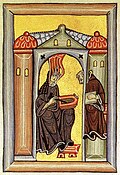 ,
Father, I am greatly disturbed by a vision which has appeared to me through divine revelation, a vision seen not with my fleshly eyes but only in my spirit.
Listen
SpotifyAbout this person
Born around 1098, Hildegard entered religious life and rose to magistra of her convent at Disibodenberg in 1136. She founded her own monastery at Rupertsberg in 1150, then a second at Eibingen in 1165. Between running both houses, she wrote theological works including Scivias (whose manuscript she supervised with miniature illuminations), botanical and medicinal texts, letters, and composed hymns and antiphons - writing both music and words, rare for any medieval composer. Her Ordo Virtutum stands as an early liturgical drama and possibly the oldest morality play. She also created Lingua Ignota, a constructed language of her own invention. Some scholars credit her as the founder of scientific natural history in Germany. She died 17 September 1179, and in 2012 Pope Benedict XVI declared her a saint and Doctor of the Church.


Fame.am measures public visibility signals. It does not measure human value, talent, morality, or credibility.