Heinrich Mann is read about 790 times a day, in 58 languages.
A typical day, 30 days to 15 October 2026
The middle day of the days counted, so one week of news cannot move it. The line under it is the last 390 days, one point a day.
Something wrong?A German novelist who spent the Weimar years skewering power and hypocrisy in prose sharp enough that the Nazis made exile his only option. The elder Mann brother, the one who saw it coming.
Also in Deutsch
Photos 8
 Heinrich Mann in seinen Münchner Jahren
 AkademieBerlin1929
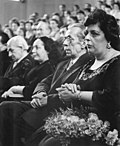
 Bundesarchiv Bild 183-81659-0008, Berlin, Beisetzung Urne Heinrich Manns, Trauerzug
 Bundesarchiv Bild 183-83255-0059, Berlin, Kranzniederlegung, Zimmering, Noll, Scheer
 Bundesarchiv Bild 183-B0510-0021-002, Berlin, Heinrich-Mann-Preis für Christa Wolf
 Bundesarchiv Bild 183-H25661, Berlin, Thomas Mann
.jpg?width=1200) Decision (1941)
Decision (1941) Emil Stumpp Heinrich Mann 1925
In their own words 1
 ,
, An intellectual who accommodates the ruling caste betrays the spirit. For the spirit is not conservative and grants no privileges.
Awards
Family
Parents
 Heinrich Mann
Partners
Brothers and sisters

Is this everyone?
Only relatives with a profile here are drawn, so a family can be larger than this. A line here can also be wrong.
Correct this familyAbout this person
Heinrich Mann built his reputation on sociopolitical novels that cut into the machinery of German society. By 1930 he'd risen to president of the fine poetry division of the Prussian Academy of Arts, a perch from which his criticism of Fascism and Nazism grew loud enough to make him a target. When the Nazis took power in 1933, he fled Germany. He was born March 27, 1871, and died March 11, 1950. His younger brother Thomas also wrote, but Heinrich got there first and left on harder terms.


Fame.am measures public visibility signals. It does not measure human value, talent, morality, or credibility.