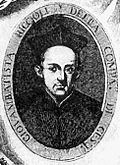
Giovanni Battista Riccioli was an Italian astronomer and a Catholic priest in the Jesuit order.
Also inDeutsch
Photos 8

 Riccioli as portrayed in the 1742 Atlas Coelestis (plate 3) of Johann Gabriel Doppelmayer.
![The crescent phases of Venus and detailed representations of its appearance as seen through a telescope, from Riccioli's 1651 New Almagest.[6]](https://upload.wikimedia.org/wikipedia/commons/thumb/2/28/Riccioli-Venus.jpg/500px-Riccioli-Venus.jpg) The crescent phases of Venus and detailed representations of its appearance as seen through a telescope, from Riccioli's 1651 New Almagest.[6]
The crescent phases of Venus and detailed representations of its appearance as seen through a telescope, from Riccioli's 1651 New Almagest.[6] Map of the Moon from the New Almagest.
 Frontispiece of Riccioli's 1651 New Almagest. Mythological figures observe the heavens with a telescope and weigh the heliocentric theory of Copernicus in a balance against his modified version of Tycho Brahe's geo-heliocentric system, in which the Sun, Moon, Jupiter, and Saturn orbit the Earth while Mercury, Venus, and Mars orbit the Sun. The old Ptolemaic geocentric theory lies discarded on the ground, made obsolete by the telescope's discoveries. These are illustrated at top and include phases of Venus and Mercury and a surface feature on Mars (left), moons of Jupiter, rings of Saturn, and features on the Moon (right). The balance tips in favor of Riccioli's "Tychonic" system.
![Illustration from Riccioli's 1651 New Almagest showing the effect a rotating Earth should have on projectiles.[36] When the cannon is fired at eastern target B, cannon and target both travel east at the same speed while the ball is in flight. The ball strikes the target just as it would if the Earth were immobile. When the cannon is fired at northern target E, the target moves more slowly to the east than the cannon and the airborne ball, because the ground moves more slowly at more northern latitudes (the ground hardly moves at all near the pole). Thus the ball follows a curved path over the ground, not a diagonal, and strikes to the east, or right, of the target at G.](https://upload.wikimedia.org/wikipedia/commons/thumb/7/72/Riccioli-Cannon.jpg/500px-Riccioli-Cannon.jpg) Illustration from Riccioli's 1651 New Almagest showing the effect a rotating Earth should have on projectiles.[36] When the cannon is fired at eastern target B, cannon and target both travel east at the same speed while the ball is in flight. The ball strikes the target just as it would if the Earth were immobile. When the cannon is fired at northern target E, the target moves more slowly to the east than the cannon and the airborne ball, because the ground moves more slowly at more northern latitudes (the ground hardly moves at all near the pole). Thus the ball follows a curved path over the ground, not a diagonal, and strikes to the east, or right, of the target at G.
Illustration from Riccioli's 1651 New Almagest showing the effect a rotating Earth should have on projectiles.[36] When the cannon is fired at eastern target B, cannon and target both travel east at the same speed while the ball is in flight. The ball strikes the target just as it would if the Earth were immobile. When the cannon is fired at northern target E, the target moves more slowly to the east than the cannon and the airborne ball, because the ground moves more slowly at more northern latitudes (the ground hardly moves at all near the pole). Thus the ball follows a curved path over the ground, not a diagonal, and strikes to the east, or right, of the target at G.![Representations from Riccioli's 1665 Reformed Astronomy of Saturn's changing appearance.[47]](https://upload.wikimedia.org/wikipedia/commons/thumb/f/f6/Riccioli-Saturn.jpg/1280px-Riccioli-Saturn.jpg) Representations from Riccioli's 1665 Reformed Astronomy of Saturn's changing appearance.[47]
Representations from Riccioli's 1665 Reformed Astronomy of Saturn's changing appearance.[47] Geographicae crucis fabrica et usus ad repraesentandam mira facilitate omnem dierum noctiumque ortuum solis et occasum, horarumque omnium varietatem, 1643
Actors born in the 1590s 6



About this person
Giovanni Battista Riccioli was an Italian astronomer and a Catholic priest in the Jesuit order. He is known, among other things, for his experiments with pendulums and with falling bodies, for his discussion of 126 arguments concerning the motion of the Earth, and for introducing the current scheme of lunar nomenclature. He is also widely known for discovering the first double star. He argued that the rotation of the Earth should reveal itself because on a rotating Earth, the ground moves at different speeds at different latitudes.
Fame.am measures public visibility signals. It does not measure human value, talent, morality, or credibility.