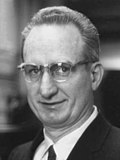
George Gamow
Russian-American theoretical physicist and cosmologist (1904-1968) · United States · On the map · Scientists · Died at 64
He bet the universe began with a bang - then worked backward through the math to prove it, predicting the faint microwave hiss still glowing from creation's first minutes. Gamow turned quantum tunneling into an explanation for how atoms fall apart and sketched the first model of the nucleus as a jittery liquid drop.
George Gamow is read about 278 times a day, in 58 languages.
A typical day, 30 days to 13 November 2026
The middle day of the days counted, so one week of news cannot move it. The line under it is the last 400 days, one point a day.
Something wrong?A life in dates
People around George


 George Gamow
Partners
Is this everyone?
Only relatives with a profile here are drawn, so a family can be larger than this. A line here can also be wrong. A marriage is drawn as ended only where its end is recorded, so a spouse drawn here may be a former one.
Correct this familyMedia & music


In their own words 1
, So I am just sitting and waiting, listening, and if something exciting comes, I just jump in.
Awards
About this person
Born Georgiy Antonovich Gamov in the Soviet Union on March 4, 1904, Gamow came up as a theoretical physicist who worked at the edge of the very small and the very large. Early on he explained alpha decay through quantum tunneling and invented the liquid drop model - the first mathematical blueprint of the atomic nucleus. He became an early champion of Georges Lemaître's Big Bang theory, developing it into a framework that stretched from radioactive decay through star formation to what he called nucleocosmogenesis: the forging of elements in stars and in the universe's first moments. He predicted the cosmic microwave background before anyone had instruments to find it, and his thinking touched molecular genetics. Later he turned to teaching and popular science, writing One Two Three... Infinity and the Mr Tompkins series - books that stayed in print for decades. He died August 19, 1968; the University of Colorado at Boulder now gives memorial lectures in his name.