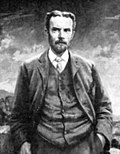
George Francis FitzGerald
Irish physicist (1851-1901) · Scientists · Died at 49
He proposed that objects shrink when they move - a idea that sounded absurd in 1889 and became the backbone of how we understand space and time.
George Francis FitzGerald is read about 25 times a day, in 42 languages.
A typical day, 30 days to 16 November 2026
The middle day of the days counted, so one week of news cannot move it. The line under it is the last 118 days, one point a day.
Something wrong?A life in dates
People around George
Family
Parents
 George Francis FitzGerald
Is this everyone?
Only relatives with a profile here are drawn, so a family can be larger than this. A line here can also be wrong.
Correct this familyMedia & music


In their own words 1
, If Universities do not study useless subjects, who will?
Awards
About this person
George Francis FitzGerald was born on 3 August 1851 in Ireland and worked as a theoretical physicist at a time when the behaviour of light was breaking classical physics. He hypothesised length contraction: the notion that an object's dimensions compress along its direction of motion, a radical fix for problems in electromagnetic theory that most dismissed as mathematical sleight of hand. Einstein's 1905 special relativity made the hypothesis fundamental - not a trick but a property of the universe itself. FitzGerald died on 21 February 1901, four years before vindication arrived.