Geoffrey Hinton
British-Canadian computer scientist and psychologist · United Kingdom · Academics · Born 1947 · age 78
Geoffrey Hinton is read about 5,022 times a day, in 66 languages.
A typical day, 30 days to 15 October 2026
The middle day of the days counted, so one week of news cannot move it. The line under it is the last 390 days, one point a day.
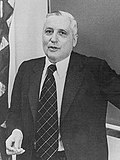
Something wrong?Geoffrey Everest Hinton is a British-Canadian computer scientist, cognitive scientist, cognitive psychologist and Nobel Prize laureate known for his work on artificial neural networks, which earned him the title "the Godfather of AI". He is University Professor Emeritus at the University of Toronto.
A life in dates
Also in Deutsch
Photos 3


In their own words 10
 ,
I got Christianity at school and Stalinism at home.
Then we got very excited because now there was this very simple local-learning rule. On paper it looked just great.
I first of all explained to him why it wouldn't work, based on an argument in Rosenblatt's book, which showed that essentially it was an algorithm that couldn't break symmetry...
Awards
In their orbit
About this person
Geoffrey Hinton was born 6 December 1947 and spent decades working on artificial neural networks when almost no one thought they'd amount to much. In 1986 he co-authored the backpropagation paper with David Rumelhart and Ronald J. Williams that gave the field a training method it could use. By 2012 his student collaboration AlexNet broke open computer vision at the ImageNet challenge and deep learning went from fringe bet to center stage. He split his time between the University of Toronto and Google Brain from 2013 to 2023, co-founded the Vector Institute in 2017, and collected the 2018 Turing Award with Yoshua Bengio and Yann LeCun, then the 2024 Nobel Prize in Physics with John Hopfield. In May 2023 he resigned from Google to speak plainly about what he now sees: malicious misuse, mass unemployment, and the chance that artificial general intelligence could outrun the people who made it.



Fame.am measures public visibility signals. It does not measure human value, talent, morality, or credibility.