Fyodor Dostoevsky is read about 13,242 times a day, in 186 languages.
A typical day, 30 days to 15 October 2026
The middle day of the days counted, so one week of news cannot move it. The line under it is the last 390 days, one point a day.
Something wrong?Dostoevsky mapped the darkest corridors of the human psyche - guilt, obsession, faith collapsing under pressure - in novels that read like philosophical crime scenes. Crime and Punishment and The Brothers Karamazov still set the terms for how fiction handles consciousness in crisis.
A life in dates
Also in Deutsch
Photos 12


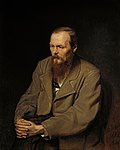
![Dostoevsky as a military engineer in 1858 or -59,[59] portrait by Solomon Leibin (Соломон Лейбин)](https://upload.wikimedia.org/wikipedia/commons/thumb/0/06/Image_dost_01.jpg/330px-Image_dost_01.jpg)


In their own words 10
 ,
, Neither a person nor a nation can exist without some higher idea.
I think that the principal and most basic spiritual need of the Russian People is the need for suffering, incessant and unslakeable suffering, everywhere and in everything.
A great many people were put down as mad among us last year. And in such language! "With such original talent" ... "and yet, after all, it appears" ...
Family
Parents

 Fyodor Dostoevsky
Partners


Children

Brothers and sisters


Is this everyone?
Only relatives with a profile here are drawn, so a family can be larger than this. A line here can also be wrong.
Correct this familyAbout this person
Born in Moscow in 1821, Dostoevsky entered literature young and broke through with Poor Folk in the mid-1840s. Then in 1849 he was arrested for discussing banned books, sentenced to death, and reprieved at the execution ground - followed by four years in a Siberian labour camp and six more in military exile. He returned to write The House of the Dead, then spent the 1860s and '70s churning out The Idiot, Demons, and The Brothers Karamazov while editing magazines, gambling away money across Western Europe, and begging for cash. Notes from Underground became a template for existentialism; Nietzsche called him the only psychologist he could learn from. He died in 1881, translated into over 170 languages, with a claim on every writer who came after.




Fame.am measures public visibility signals. It does not measure human value, talent, morality, or credibility.