Ernest Hemingway
American author and journalist (1899-1961) · United States · Writers · Died at 61
Ernest Hemingway is read about 10,631 times a day, in 153 languages.
A typical day, 30 days to 15 October 2026
The middle day of the days counted, so one week of news cannot move it. The line under it is the last 390 days, one point a day.
Something wrong?The prose stripped to bone, the life lived at full tilt - Hemingway made both a style and a performance, and American writing bent toward his example. Novels that became syllabus fixtures, a Nobel, a public persona built on bullfights and wars and hard drinking, then the shotgun in Idaho.
A life in dates
Also in Deutsch
Photos 12
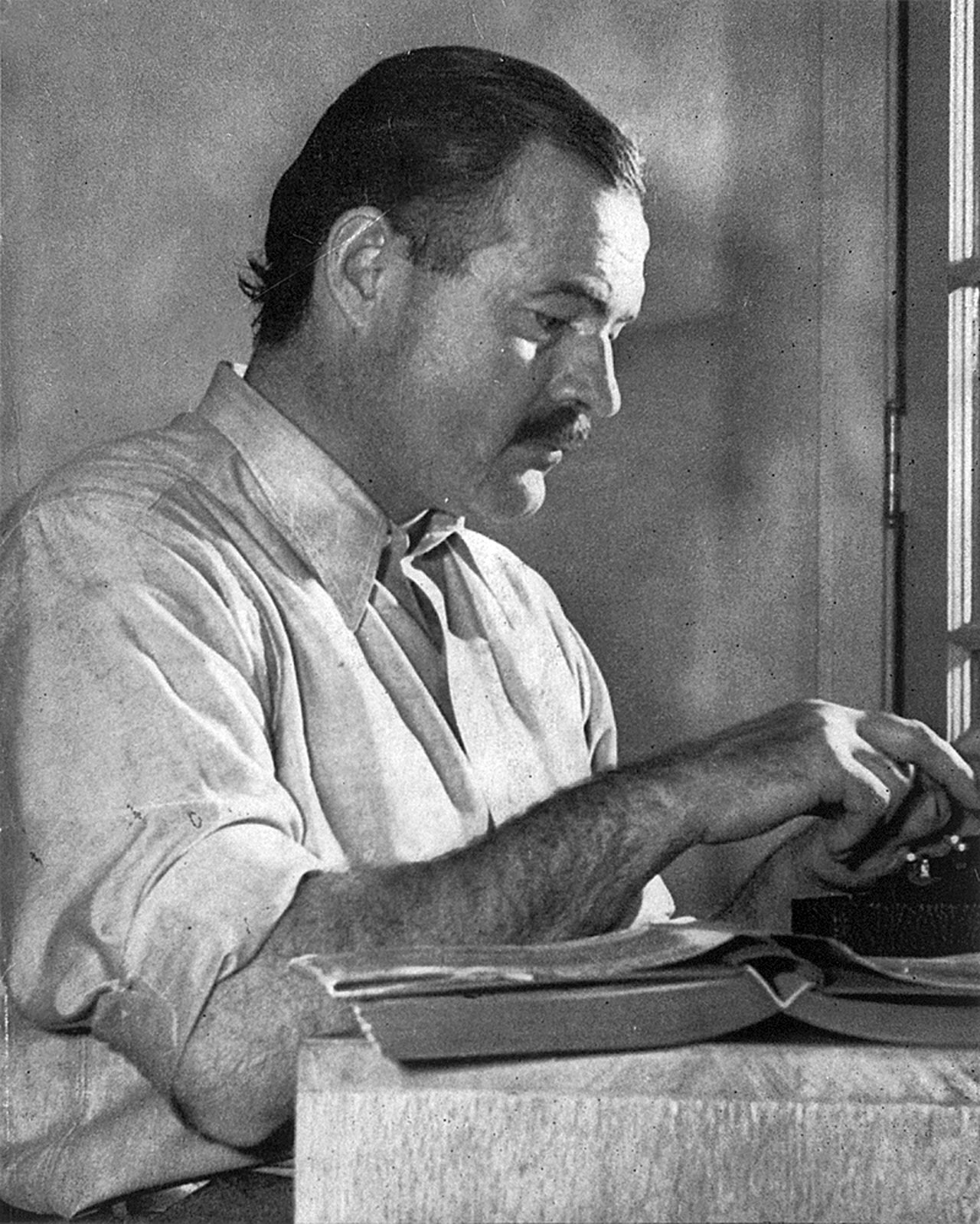
 Ernest Hemingway Boyhood Home, Oak Park, Illinois
 Hemingway was the second child and first son born to Clarence and Grace.
![Hemingway as 1st Lt. (A.R.C.), in late 1918 (note the medal ribbons on his chest and the two rank stripes above the cuffs)[12]](https://upload.wikimedia.org/wikipedia/commons/thumb/f/f1/EH2723PMilan1918.jpg/500px-EH2723PMilan1918.jpg) Hemingway as 1st Lt. (A.R.C.), in late 1918 (note the medal ribbons on his chest and the two rank stripes above the cuffs)[12]
Hemingway as 1st Lt. (A.R.C.), in late 1918 (note the medal ribbons on his chest and the two rank stripes above the cuffs)[12] In Milan in 1918
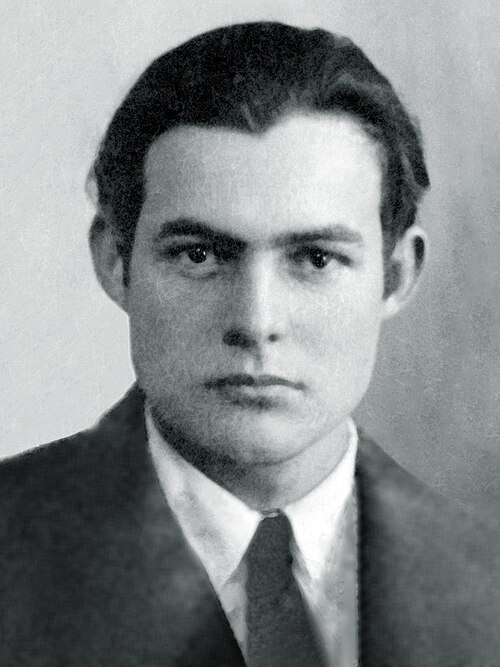 Hemingway's 1923 passport photo; at this time, he lived in Paris with his wife Hadley and worked as a foreign correspondent for the Toronto Star Weekly.
 Ernest, Hadley, and Bumby Hemingway in Schruns, Austria, in 1926, months before they separated
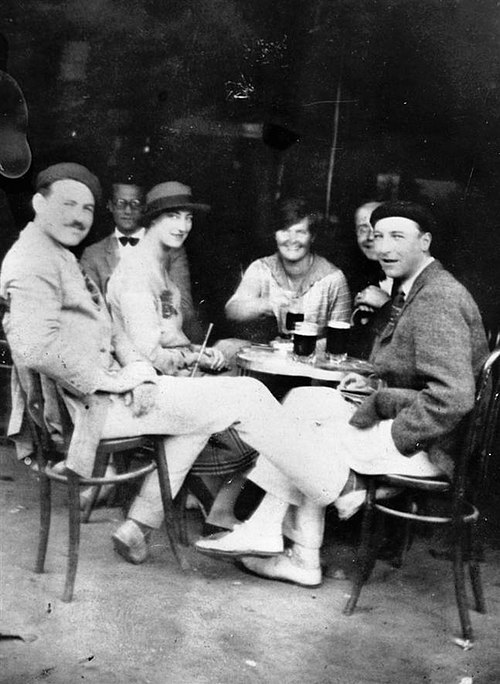 From left to right: Ernest Hemingway, Harold Loeb, Lady Duff Twysden, Hadley Hemingway, Donald Ogden Stewart, and Patrick Stirling Guthrie, at a café in Pamplona, Spain, July 1925.
In their own words 10
 ,
, In the fall the war was always there but we did not go to it any more.
I've tried to reduce profanity but I reduced so much profanity when writing the book that I'm afraid not much could come out.
I wonder what your idea of heaven would be - A beautiful vacuum filled with wealthy monogamists. All powerful and members of the best families all drinking themselves to death.
Awards
Family
Parents
 Ernest Hemingway
Partners


Children

Brothers and sisters

Is this everyone?
Only relatives with a profile here are drawn, so a family can be larger than this. A line here can also be wrong.
Correct this familyAbout this person
Raised in suburban Oak Park, Illinois, he broke for The Kansas City Star after high school, then drove ambulances on the Italian Front in World War I until shrapnel tore through him in 1918. By 1921 he'd landed in Paris as a foreign correspondent for the Toronto Star, falling in with the Lost Generation expatriates who pushed him toward the lean modernist line that became his signature. The Sun Also Rises arrived in 1926, followed by A Farewell to Arms in 1929, both mined from the war years. He spent the 1930s in Key West, then Havana, covering the Spanish Civil War in 1937 - which fed For Whom the Bell Tolls in 1940 - and riding with Allied troops as a journalist through Normandy and the liberation of Paris in World War II. The Old Man and the Sea won the Pulitzer in 1952; the Nobel came in 1954, the same year two plane crashes in Africa left him broken and in chronic pain. He died by his own hand in Ketchum, Idaho, in 1961.
In common with Ernest




Fame.am measures public visibility signals. It does not measure human value, talent, morality, or credibility.