Elie Wiesel
Romanian-born American writer, professor, political activist, Nobel laureate, and Holocaust survivor (1928-2016) · United States · Writers · Died at 87 · also Israel
Elie Wiesel is read about 1,587 times a day, in 82 languages.
A typical day, 30 days to 15 October 2026
The middle day of the days counted, so one week of news cannot move it. The line under it is the last 390 days, one point a day.
Something wrong?He survived Auschwitz and Buchenwald, then spent the rest of his life refusing to let the world forget. His memoir Night became required reading, and his voice - insistent, moral, unsparing - made him the most visible witness to the Holocaust's reach into the present tense.
A life in dates
Also in Deutsch
Photos 8
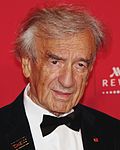
 Elie Wiesel 2012 Shankbone
_by_Erling_Mandelmann.jpg?width=1200) Elie Wiesel (1987) by Erling Mandelmann
Elie Wiesel (1987) by Erling Mandelmann Elie Wiesel redux
 Barack Obama at Holocaust Days of Remembrance Ceremony 4-23-09
.jpg?width=1200) A convention of victims who survived the Holocaust in the Bergen Belzen concentration camp was held at the diaspora museum Beit Hatfutzot (FL45830174)
A convention of victims who survived the Holocaust in the Bergen Belzen concentration camp was held at the diaspora museum Beit Hatfutzot (FL45830174).jpg?width=1200) A convention of victims who survived the Holocaust in the Bergen Belzen concentration camp was held at the diaspora museum Beit Hatfutzot (FL45830189)
A convention of victims who survived the Holocaust in the Bergen Belzen concentration camp was held at the diaspora museum Beit Hatfutzot (FL45830189).jpg?width=1200) A convention of victims who survived the Holocaust in the Bergen Belzen concentration camp was held at the diaspora museum Beit Hatfutzot (FL45830233)
A convention of victims who survived the Holocaust in the Bergen Belzen concentration camp was held at the diaspora museum Beit Hatfutzot (FL45830233)In their own words 10
 ,
, I have not lost faith in God. I have moments of anger and protest. Sometimes I've been closer to him for that reason.
What hurts the victim most is not the cruelty of the oppressor but the silence of the bystander.
Time does not heal all wounds; there are those that remain painfully open.
Awards
Family
Parents
Elie WieselPartners

Is this everyone?
Only relatives with a profile here are drawn, so a family can be larger than this. A line here can also be wrong.
Correct this familyAbout this person
Eliezer Wiesel was born in Romania on September 30, 1928, and was deported as a teenager to Auschwitz and Buchenwald. After liberation, he wrote Night, a spare account of those years that became one of the defining texts of Holocaust literature. He went on to write 56 more books, mostly in French and English, and became a professor of humanities at Boston University, where the university later founded a center for Jewish studies in his name. His activism stretched across decades and continents: he spoke for Soviet Jews, against apartheid in South Africa, and against genocides in Rwanda, Bosnia, Darfur, and Cambodia, among other causes. He was also an outspoken advocate for Israel, backing Netanyahu and opposing territorial compromise in Jerusalem. In 1986 he received the Nobel Peace Prize, and in 1993 he helped establish the United States Holocaust Memorial Museum. He died on July 2, 2016.
In common with Elie
 Joseph WisemanAlso in Zalmen, or The Madness of God (1975)
 Anne WiazemskyAlso in Le Testament d'un poète juif assassiné (1988)
 Miklós JancsóAlso in The Dawn (1986)
 Sarah AdlerAlso in Dawn (2015)
 Judit ElekAlso in Elie Wiesel Goes Home (1997)
 Ann ZachariasAlso in Le Testament d'un poète juif assassiné (1988)
Fame.am measures public visibility signals. It does not measure human value, talent, morality, or credibility.