Elias Canetti
Bulgarian-born Swiss and British Jewish modernist novelist, playwright, memoirist, and non-fiction writer (1905-1994) · United Kingdom · Writers · Died at 89
Elias Canetti is read about 627 times a day, in 88 languages.
A typical day, 30 days to 15 October 2026
The middle day of the days counted, so one week of news cannot move it. The line under it is the last 390 days, one point a day.
Something wrong?A modernist who spent decades mapping the physics of mobs - how they form, when they break, what they want from the bodies inside them. The Nobel came in 1981 for a career built in the margins: novels, memoirs, and one strange treatise on mass behavior that no discipline could quite claim.
A life in dates
Also in Deutsch
Photos 8


.jpg?width=1200)
.jpg?width=1200)


In their own words 10
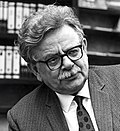 ,
, I was never drawn to experiment with language; I take note of such experiments, but avoid them in my own writing. The reason is that the substance of life claims me completely.
Is there still a possibility of public truth? The prime condition for that would be that you pose your own questions, not just answer them.
I hate judgments that only crush and don’t transform.
Listen
SpotifyAwards
Family
Elias CanettiPartners
Brothers and sisters


Is this everyone?
Only relatives with a profile here are drawn, so a family can be larger than this. A line here can also be wrong.
Correct this familyAbout this person
Born in 1905 in Ruse, Bulgaria, to a Sephardic Jewish family, Canetti wrote in German across a life scattered through England, Austria, Germany, and Switzerland. He worked as a novelist, playwright, and memoirist, but his signature effort was the nonfiction book "Crowds and Power," a study of collective behavior that defied easy categorization. The Nobel committee cited "writings marked by a broad outlook, a wealth of ideas and artistic power" when they gave him the literature prize in 1981. He died in 1994, thirteen years after the recognition arrived.




Fame.am measures public visibility signals. It does not measure human value, talent, morality, or credibility.