Edwin Lutyens
British architect (1869-1944) · United Kingdom · Architects · Died at 74
Edwin Lutyens is read about 260 times a day, in 41 languages.
A typical day, 30 days to 15 October 2026
The middle day of the days counted, so one week of news cannot move it. The line under it is the last 83 days, one point a day.
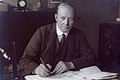
Something wrong?He conjured New Delhi out of imperial ambition and local stone - the grand sweep of what became Lutyens' Delhi, including the Viceroy's House that now holds India's presidency. A century later, his war memorials and country houses still anchor arguments about whether England has produced a greater architect since Wren.
A life in dates
Also in Deutsch
Photos 12

 Ground floor plan of Munstead Wood
 Ground floor plan of Orchards
 The Cenotaph, Whitehall, London
 Lutyens's design for The Cenotaph
 Lutyens's Midland Bank Building in Manchester, constructed in 1935
 Rashtrapati Bhavan, the home of the President of India, was designed by Lutyens.
 13 Mansfield Street, Marylebone, Lutyens's London home from 1919 to his death in 1944
Awards
Family
Parents


 Edwin Lutyens
Partners
Children


Is this everyone?
Only relatives with a profile here are drawn, so a family can be larger than this. A line here can also be wrong.
Correct this familyAbout this person
Born 29 March 1869, Lutyens learned to bend Georgian proportion and Mughal detail to the needs of Edwardian clients and later an empire looking to plant permanence in India. From the 1890s he built English country houses that married invention with tradition; after 1912 he shaped New Delhi alongside Herbert Baker, designing the Viceroy's House - now Rashtrapati Bhavan - and the India Gate, drawing heavily on Indian architectural forms. He spent his career adapting old languages to new demands, a method that earned him election as Master of the Art Workers' Guild in 1933. Christopher Hussey called him the greatest English architect since Wren, possibly better; Gavin Stamp went further and named him the greatest British architect of the twentieth century or any other. He died 1 January 1944, leaving a portfolio that still defines how power and memory look in stone.
In common with Edwin


Architects from the United Kingdom 2

Fame.am measures public visibility signals. It does not measure human value, talent, morality, or credibility.