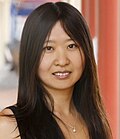
Doris Tsao
✓ Source-basedstableAmerican neuroscientist
Doris Ying Tsao is an American neuroscientist and professor of neurobiology and molecular cell biology at the University of California, Berkeley. She was formerly on the faculty at the California Institute of Technology for 12 years.
Text from Wikipedia, CC BY-SA 4.0
Photos 1

On YouTube
4 subscribersAwards 7
Connected to Doris 6
 Pan JianweiAlso won Sofia Kovalevskaya Award
 Huda ZoghbiAlso won Kavli Prize in Neuroscience
 Marc Tessier-LavigneAlso won W. Alden Spencer AwardKarl J. FristonAlso won Golden Brain Award
 Giulio TononiAlso won National Institutes of Health Director's Pioneer Award
 Jean-Pierre ChangeuxAlso won Karl Spencer Lashley Award
About this person
Doris Ying Tsao is an American neuroscientist and professor of neurobiology and molecular cell biology at the University of California, Berkeley. She was formerly on the faculty at the California Institute of Technology for 12 years. She is recognized for pioneering the use of fMRI with single-unit electrophysiological recordings and for discovering the macaque face patch system for face perception. She is a Howard Hughes Medical Institute Investigator and the director of the T&C Chen Center for Systems Neuroscience. She won a MacArthur "Genius" fellowship in 2018. Tsao was elected a member of the National Academy of Sciences in 2020. In 2024 she was awarded a Kavli Prize in neuroscience along with Nancy Kanwisher and Winrich Freiwald for the discovery and study of specific areas in the brain that perform facial recognition. In 2024, Tsao received the Rosenstiel Award. After joining UC Berkeley in 2021, her current research explores visual perception in primates in order to understand how the brain creates our sense of reality.
Text from Wikipedia, CC BY-SA 4.0
 United States
Fame.am measures public visibility signals. It does not measure human value, talent, morality, or credibility.