
Doris Miller
✓ Source-basedrisingFirst African American to be awarded the Navy Cross (1919-1943)
 United StatesLived 1919 to 1943 · aged 24
A mess attendant who grabbed an anti-aircraft gun he'd never been trained to use and started firing back at Japanese planes over Pearl Harbor - then watched the Navy Cross land in his hands while the Medal of Honor stayed out of reach.
Text from Wikipedia, CC BY-SA 4.0
Also inDeutsch
Photos 10

 Illustration of Miller defending the fleet at Pearl Harbor (Charles Alston, Office of War Information and Public Relations)
 Admiral Chester W. Nimitz pins a Navy Cross on Mess Attendant Second Class Miller during a ceremony aboard the USS Enterprise (CV-6) at Pearl Harbor, on May 27, 1942.
 Miller speaking with sailors and a civilian at Great Lakes Naval Training Station, January 7, 1943
 1943 U.S. Navy recruiting poster featuring Miller and his Navy Cross
 Commemorative plaque for Dorie Miller at the National Museum of the Pacific War
 Dorie Miller memorial at the housing cooperative named for him in Corona, Queens
 Doris Miller Auditorium in Austin, Texas
Awards 8
Connected to Doris 6


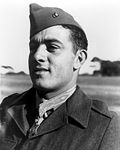

About this person
Doris "Dorie" Miller was born October 12, 1919, and by December 7, 1941, he was a mess attendant second class on the USS West Virginia, one of the only roles open to Black sailors. When the bombs hit Pearl Harbor, he carried wounded men to safety, then manned an anti-aircraft gun with no gunnery training and shot down at least one plane, possibly as many as six by his own account. Admiral Chester Nimitz pinned the Navy Cross on him on May 27, 1942, making Miller the first Black recipient, but Secretary of the Navy Frank Knox - who opposed Black sailors in combat - blocked the Medal of Honor nomination that a congressman and senator had filed. Miller made cook petty officer third class by June 1943. On November 24, 1943, a Japanese torpedo sank the escort carrier Liscome Bay during the Battle of Makin, killing Miller and 701 others in the deadliest carrier loss in U.S. Navy history. Two ships now carry his name: a frigate commissioned in 1973, and a Ford-class carrier scheduled to launch in 2029 - the first carrier named for an African American and the first for an enlisted sailor's combat actions.
Text from Wikipedia, CC BY-SA 4.0
United StatesFame.am measures public visibility signals. It does not measure human value, talent, morality, or credibility.