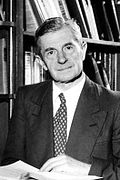
Don L. Anderson
American geophysicist (1933-2014) · United States · On the map · Academics · Died at 81
Don Lynn Anderson was an American geophysicist who made significant contributions to the understanding of the origin, evolution, structure, and composition of Earth and other planets.
Don L. Anderson is read about 6.5 times a day, in 14 languages.
A typical day, 30 days to 17 June 2026
The middle day of the days counted, so one week of news cannot move it. The line under it is the last 60 days, one point a day.
Something wrong?A life in dates
Media & music



Awards
About this person
An expert in numerous scientific disciplines, Anderson's work combined seismology, solid state physics, geochemistry and petrology to explain how the Earth works. Anderson was best known for his contributions to the understanding of the Earth's deep interior, and more recently, for the plate theory hypothesis that hotspots are the product of plate tectonics rather than narrow plumes emanating from the deep Earth. Anderson was Professor (Emeritus) of Geophysics in the Division of Geological and Planetary Sciences at the California Institute of Technology (Caltech). He received numerous awards from geophysical, geological and astronomical societies. In 1998 he was awarded the Crafoord Prize by the Royal Swedish Academy of Sciences along with Adam Dziewonski. Later that year, Anderson received the National Medal of Science. He held honorary doctorates from Rensselaer Polytechnic Institute and the University of Paris (Sorbonne), and served on numerous university advisory committees, including those at Harvard, Princeton, Yale, University of Chicago, Stanford, University of Paris, Purdue University, and Rice University. Anderson's wide-ranging research resulted in hundreds of published papers in the fields of planetary science, seismology, mineral physics, petrology, geochemistry, tectonics and the philosophy of science.