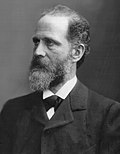
David Gill
Scottish astronomer (1843-1914) · Scientists · Died at 70
Sir David Gill was a Scottish astronomer who spent most of his career as H.M. Astronomer at the Cape of Good Hope. He was born in Aberdeen, trained as a watch and clock-maker, and spent ten years in the family business, which he took over from his father.
David Gill is read about 16 times a day, in 26 languages.
A typical day, 30 days to 17 September 2026
The middle day of the days counted, so one week of news cannot move it. The line under it is the last 60 days, one point a day.
Something wrong?A life in dates
Also in Français
Media & music
Photos 12

 Isobel Black and David Gill before their marriage
 Map showing the chain of longitude determinations in 1874. Solid red: telegraph; dashed blue: chronometer. Both methods were used for the Suez to Aden link.[11]


 Camp at Mars Bay, Ascension Island, 1877
 1884 Map of Ascension Island showing Georgetown, where the observatory was originally set up, and Mars Bay
Awards
About this person
He became a noted amateur astronomer, and was invited by Lord Lindsay to manage his private observatory, which he accepted, selling the family busisness. He took part in astronomical expeditions to Mauritius and Ascension Island, before being appointed to the Cape in 1879. He was particularly noted for his observations with the heliometer, using this instrument for measurement of parallax in order to determine distances, both from the earth to the sun and from our solar system to other stars. At the Cape, he developed the observatory, making it a world-class institution. He was a pioneer of astrophotography, and used photographic methods to create a star atlas of the southern hemisphere, and also supported and took part in the world-wide Carte du Ciel star-mapping project. He was a meticulous observer, taking great trouble to identify and eliminate systematic sources of error. He was a proponent of international cooperation, supporting international projects and collaborating with many of the other leading astronomers of his day. He helped initiate a geodetic survey of Southern Africa which eventually connected with North cape to provide the longest meridian arc in the world, providing a basis for cartography, navigation and astronomical observations.