Dante Alighieri
Florentine poet, writer, and philosopher (c. 1265-1321) · Writers · Died at 56
Dante Alighieri is read about 6,275 times a day, in 200 languages.
A typical day, 30 days to 21 October 2026
The middle day of the days counted, so one week of news cannot move it. The line under it is the last 396 days, one point a day.
Something wrong?He wrote a poem about walking through Hell, Purgatory, and Heaven - and it became the blueprint for how the West imagines the afterlife. Seven centuries later, the Divine Comedy still shapes art, literature, and the popular picture of damnation.
Also in Deutsch
Photos 9

![Dante's house museum in Florence. The house has been significantly altered since Dante's time.[18]](https://upload.wikimedia.org/wikipedia/commons/thumb/7/74/Casa_di_dante_01.JPG/1280px-Casa_di_dante_01.JPG) Dante's house museum in Florence. The house has been significantly altered since Dante's time.[18]
Dante's house museum in Florence. The house has been significantly altered since Dante's time.[18]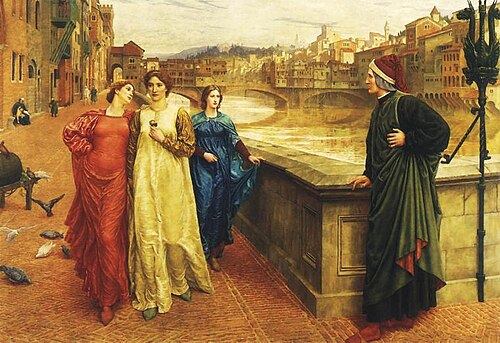 Dante and Beatrice, by Henry Holiday, inspired by La Vita Nuova, 1883
 Dante in Verona, by Antonio Cotti, 1879

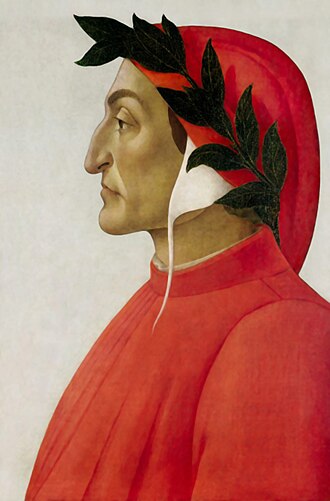 Posthumous portrait in tempera by Sandro Botticelli, 1495
 Dante and Virgil visiting Hell, as depicted in Inferno, painted by Rafael Flores, 1855
In their own words 1
 ,
, Lasciate ogni speranza, voi ch'entrate.
Family
Parents
 Dante Alighieri
Partners

Children

Is this everyone?
Only relatives with a profile here are drawn, so a family can be larger than this. A line here can also be wrong.
Correct this familyAbout this person
Born around May 1265, Dante Alighieri came of age in Florence when Latin still ruled the page and Italian poets borrowed from France. He broke both habits: he wrote in Tuscan, the vernacular of his city, and defended it in De vulgari eloquentia as fit for serious work. The New Life appeared in 1295; the Divine Comedy followed, a journey through the three realms that Boccaccio would later call "divine." The poem's terza rima - interlocking three-line rhyme - was his invention. His choice of dialect became the foundation of modern Italian, and his influence bled across borders: Chaucer, Milton, Tennyson all drew from him. He died in exile on September 14, 1321, but Italy calls him il Sommo Poeta, the Supreme Poet, and he remains one of the crowns of its literature.



Fame.am measures public visibility signals. It does not measure human value, talent, morality, or credibility.