Constantine the Great
Roman emperor from 306 to 337 and first to convert to Christianity (272-337) · Historical Figures · Died at 65
Constantine the Great is read about 5,671 times a day, in 141 languages.
A typical day, 30 days to 15 October 2026
The middle day of the days counted, so one week of news cannot move it. The line under it is the last 390 days, one point a day.
Something wrong?He turned the Roman Empire Christian. Constantine legalized a persecuted faith, summoned the council that wrote the Nicene Creed, and built Constantinople as a new capital that outlasted Rome itself by a thousand years.
Also in Deutsch
Photos 8


In their own words 3
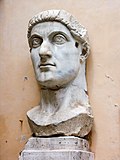 ,
Some time ago a most salutary sanction of our constitution was promulgated, which we now make doubly noteworthy by the repetition of our law.
How pleasing to the wise and intelligent portion of mankind is the concord which exists among you!
By keeping the Divine faith, I am made a partaker of the light of truth: guided by the light of truth, I advance in the knowledge of the Divine faith.
Family
Parents

 Constantine the Great
Partners


Children


Brothers and sisters

Is this everyone?
Only relatives with a profile here are drawn, so a family can be larger than this. A line here can also be wrong.
Correct this familyAbout this person
Born in 272 in Naissus to a low-born Greek mother and an army officer who would become emperor, Constantine rose through the ranks under Diocletian and Galerius, fighting Persians in the east and campaigning in Britannia with his father. When his father died in 306, the army proclaimed him augustus at York. He spent the next eighteen years in civil war, defeating rival emperors Maxentius and Licinius to claim sole rule by 324. As emperor he restructured the government, introduced the solidus gold coin that anchored currency for a millennium, disbanded the Praetorian Guard, and reorganized the army into mobile strike forces and frontier garrisons. He lived most of his life as a pagan before favouring Christianity in 312 and being baptised on his deathbed by an Arian bishop in 337. The Edict of Milan in 313 ended Christian persecution; the First Council of Nicaea in 325 produced the creed that defined orthodoxy. He rebuilt Byzantium as Constantinople and made it the imperial seat, leaving an empire that would pass to his sons and, through the eastern half, endure another thousand years.
Fame.am measures public visibility signals. It does not measure human value, talent, morality, or credibility.