Chien-Shiung Wu
Chinese-American physicist (1912-1997; death at 85 years) · United States · Scientists · Died at 84
Chien-Shiung Wu is read about 400 times a day, in 57 languages.
A typical day, 30 days to 16 September 2026
The middle day of the days counted, so one week of news cannot move it. The line under it is the last 361 days, one point a day.
Something wrong?Chien-Shiung Wu was a Chinese-American particle and experimental physicist who made significant contributions in the fields of nuclear and particle physics. Wu worked on the Manhattan Project, where she helped develop the process for separating uranium into uranium-235 and uranium-238 isotopes by gaseous diffusion.
A life in dates
Also in Deutsch
Photos 12

 Wu studied at Mingde Middle School. The backmost building is named for her.
 Chien-Shiung Wu Memorial Museum, Southeast University.
 Wu (right) in an outing with Margaret Lewis in Berkeley, California
 Chien-Shiung Wu and Luke Yuan (left) at the home of Mr. and Mrs. Robert Millikan (right) on their wedding day
 Chien-Shiung Wu's experimental results were a huge influence to other physicists and were duplicated by many scientists
 Chien-Shiung Wu in 1963 at Columbia University
 Mao Zedong and Chiang Kai-shek would fight for the fate of the country immediately after the united Chinese forces won the Second World War.
Awards
Family
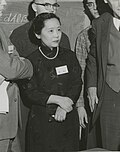 Chien-Shiung Wu
Partners

Is this everyone?
Only relatives with a profile here are drawn, so a family can be larger than this. A line here can also be wrong.
Correct this familyAbout this person
Chien-Shiung Wu was a Chinese-American particle and experimental physicist who made significant contributions in the fields of nuclear and particle physics. Wu worked on the Manhattan Project, where she helped develop the process for separating uranium into uranium-235 and uranium-238 isotopes by gaseous diffusion. She is best known for conducting the Wu experiment, which proved that parity is not conserved. This discovery resulted in her colleagues Tsung-Dao Lee and Chen-Ning Yang winning the 1957 Nobel Prize in Physics, while Wu herself was awarded the inaugural Wolf Prize in Physics in 1978. Her expertise in experimental physics evoked comparisons to Marie Curie. Her nicknames include the "First Lady of Physics", the "Chinese Marie Curie" and the "Queen of Nuclear Research".
In common with Chien-Shiung
 John ClarkeBoth received Comstock Prize in Physics
 Robert J. Van de GraaffBoth received Tom W. Bonner Prize in Nuclear Physics
 Yakir AharonovBoth received Wolf Prize in Physics
 John Robert SchriefferBoth received Comstock Prize in Physics
 Joseph Hooton Taylor Jr.Both received Wolf Prize in Physics
 Maurice GoldhaberBoth received Tom W. Bonner Prize in Nuclear Physics
Fame.am measures public visibility signals. It does not measure human value, talent, morality, or credibility.