Catherine the Great
Eighth Emperor of Russia, called the Great, r. 1762-1796 (lived 1729-1796) · Russia · Historical Figures · Died at 67
Catherine the Great is read about 12,298 times a day, in 121 languages.
A typical day, 30 days to 15 October 2026
The middle day of the days counted, so one week of news cannot move it. The line under it is the last 390 days, one point a day.
Something wrong?She seized the Russian throne from her husband in a coup - possibly had him killed - then ruled for thirty-four years, expanding the empire further than any monarch since Peter the Great while hosting Enlightenment thinkers and founding universities.
A life in dates
Also in Deutsch
Photos 12

 Catherine in her childhood, by Anna Rosina de Gasc, 1742
 Catherine as Grand Duchess around the time of her marriage (portrait by Louis Caravaque, 1745)
 An equestrian portrait of Grand Duchess Ekaterina Alekseyevna from before 1749
 Emperor Peter III and his wife, the future Catherine the Great. He reigned only six months, and died on 17 July 1762.
 Profile portrait of Grand Duchess Catherine Alexeievna by Vigilius Eriksen, c. 1762
 Catherine II on a balcony of the Winter Palace on 9 July [O.S. 28 June] 1762, the day of the coup
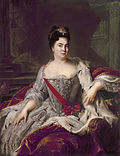
 Coronation portrait by Stefano Torelli, 1763-1766
In their own words 10
 ,
It is better to be subject to the Laws under one Master, than to be subservient to many.
What is the true End of Monarchy? Not to deprive People of their natural Liberty; but to correct their Actions, in order to attain the supreme Good.
The Governing Senate. . . has deemed it necessary to make known... that the landlords' serfs and peasants . . .
Awards
Family
Parents

 Catherine the Great
Partners


Children


Brothers and sisters

Is this everyone?
Only relatives with a profile here are drawn, so a family can be larger than this. A line here can also be wrong.
Correct this familyAbout this person
Born Princess Sophia Augusta Frederica of Anhalt-Zerbst on 2 May 1729, she arrived in Russia as a minor German noble and became Empress in 1762 after overthrowing Peter III. Her reign stretched to 1796 and redrew the map: she installed a former lover on the Polish throne before partitioning the country, annexed the Crimean Khanate after victories over the Ottomans, and pushed Russian settlement to Alaska in the east and the Black Sea coast in the south. She founded cities - Yekaterinoslav, Kherson, Sevastopol - and the Smolny Institute, Europe's first state-funded women's college. She freed the nobility from compulsory service, filled the countryside with neoclassical estates, and governed through alliances with favourites like Grigory Orlov and Grigory Potemkin. Serfdom intensified under the weight of her wars and expansion, sparking Pugachev's Rebellion. She died 17 November 1796, having turned Russia into a recognised great power and herself into the model of the enlightened despot.
Historical Figures from Russia 5


Fame.am measures public visibility signals. It does not measure human value, talent, morality, or credibility.