Carl Jung
Swiss psychiatrist and psychotherapist (1875-1961) · Switzerland · Doctors · Died at 85
Carl Jung is read about 7,834 times a day, in 112 languages.
A typical day, 30 days to 15 October 2026
The middle day of the days counted, so one week of news cannot move it. The line under it is the last 390 days, one point a day.
Something wrong?The Swiss psychiatrist who split from Freud and built his own system around archetypes, the collective unconscious, and individuation - ideas that escaped the clinical world and seeped into literature, religion, and how millions of people talk about personality.
A life in dates
Also in Deutsch
Photos 12


 Birthplace in Kesswil
 The clergy house in Kleinhüningen, Basel, where Jung grew up
 Jung as a child, early 1880s
 Old main building of the University of Basel (foreground), where Jung studied between 1895 and 1900
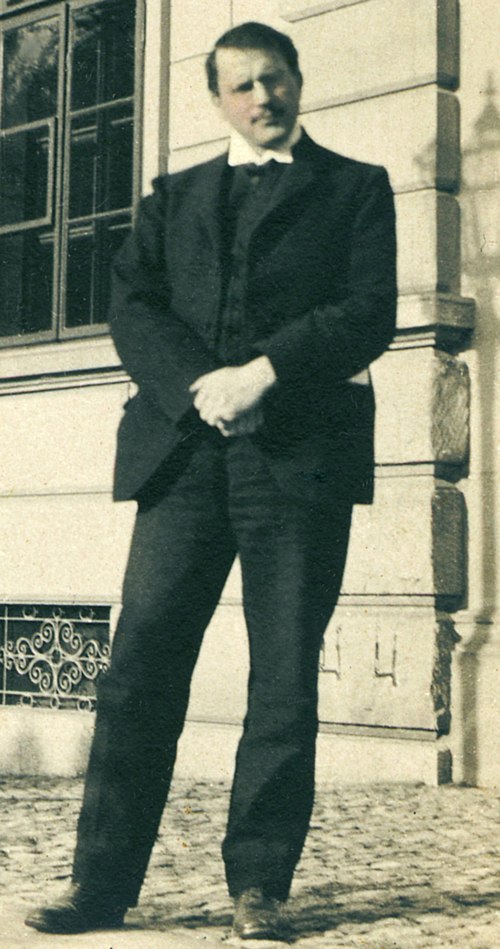 Jung outside Burghölzli in 1910
 Emma Jung in 1911. She assisted her husband in his early research before becoming a psychoanalyst and author.
In their own words 10
Emotion is the chief source of all becoming-conscious. There can be no transforming of darkness into light and of apathy into movement without emotion.
Education to personality" has become a pedagogical ideal that turns its back upon the standardized - the collective and normal - human being.
This whole creation is essentially subjective, and the dream is the theater where the dreamer is at once scene, actor, prompter, stage manager, author, audience, and critic.
Awards
Family
Parents
Partners

Is this everyone?
Only relatives with a profile here are drawn, so a family can be larger than this. A line here can also be wrong.
Correct this familyAbout this person
Carl Gustav Jung was born 26 July 1875 and worked as a research scientist at the Burghölzli psychiatric hospital in Zurich under Eugen Bleuler. He developed a friendship and lengthy correspondence with Freud, who saw the younger Christian-raised Jung as the heir to psychoanalysis and a hedge against rising antisemitism in Europe; Freud secured Jung's appointment as president of the newly founded International Psychoanalytical Association. But Jung's research and vision made it difficult to follow Freud's doctrine, and the painful split led Jung to establish analytical psychology as a separate system. He created concepts like synchronicity, the psychological complex, extraversion and introversion, and individuation - the lifelong process of differentiating the self from conscious and unconscious elements, which he considered the main task of human development. His 1926 treatment of Rowland Hazard, rooted in the conviction that alcoholics may recover through a vital spiritual experience, set in motion the chain of events that led to Alcoholics Anonymous. A prolific author of over twenty books, illustrator, craftsman, and builder, Jung died 6 June 1961, with many w



Fame.am measures public visibility signals. It does not measure human value, talent, morality, or credibility.