Bhagat Singh
Indian revolutionary (1907-1931) · Activists · Died at 23
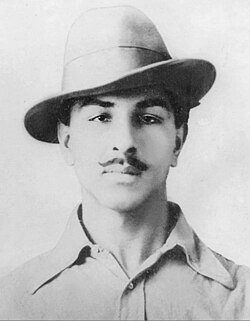
At 23, Bhagat Singh was hanged by the British Raj for a botched assassination and a symbolic bombing - but the execution made him something larger than the acts.
Bhagat Singh is read about 1,642 times a day, in 44 languages.
A typical day, 30 days to 1 November 2026
The middle day of the days counted, so one week of news cannot move it. The line under it is the last 400 days, one point a day.
Something wrong?A life in dates
People around Bhagat
Close ties

Also in Deutsch
Media & music


In their own words 4
 ,
Compromise is an essential weapon which has to be wielded every now and then as the struggle develops.
Revolution is a very difficult task. It is beyond the power of any man to make a revolution. Neither can it be brought about on any appointed date.
One should not interpret the word “Revolution” in its literal sense.
About this person
Bhagat Singh shot a 21-year-old probationary British officer named John Saunders in December 1928, mistaking him for the senior superintendent they believed responsible for nationalist leader Lala Lajpat Rai's death after a baton charge. Months on the run, Singh surfaced in April 1929 to detonate low-intensity bombs in Delhi's Central Legislative Assembly with Batukeshwar Dutt - no casualties, just leaflets and slogans and a deliberate arrest. The publicity exposed his role in the Saunders killing. A hunger strike in jail, which ended in fellow prisoner Jatin Das starving to death, turned sympathy into legend. Singh, an atheist drawn to Bolshevism and anarchism, was hanged in March 1931. Nehru later wrote that people forgot the act and kept the symbol: in the Punjab and across northern India, Singh became the Shaheed-e-Azam, claimed by communists and Hindu nationalists alike, lionized in popular art long after his co-revolutionaries faded.