Bahadur Shah Zafar
18th and last Mughal Emperor from 1837 to 1857 · India · Historical Figures · Lived 1775 to 1862 · aged 87
Bahadur Shah Zafar is read about 920 times a day, in 61 languages.
A typical day, 30 days to 5 October 2026
The middle day of the days counted, so one week of news cannot move it. The line under it is the last 380 days, one point a day.
Something wrong?The last Mughal emperor was a poet whose authority ended at Delhi's walls - until rebels in 1857 declared him Emperor of India against the East India Company, a claim that cost him his throne and sent him to die in exile in Rangoon.
Also in Deutsch
Photos 8
 Bahadur Shah II
 A daring seizure of King of Delhi by by Capt Henry M Hodson of Hodson's Horse
 A panorama in 12 folds showing the procession of the Emperor Bahadur Shah to celebrate the feast of the 'Id., 1843
 Bahadur Shah II (cropped)
 Bahadur Shah II - aka Zafar - Project Gutenberg eText 17711
 Bahadur Shah II 00
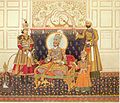
 Bahadur Shah II in darbar (6124538615)
 Bahadur Shah II in darbar, 1837, San Diego Museum of Art
In their own words 4
 ,
My heart has no repose in this despoiled land / Who has ever felt fulfilled in this futile world?
I wish you had made me the master of royals, / Or made my crown the bowl for alms and betrayals.
The heart is asunder, singed to a kebab, This love has been the disaster of my life.
Family
Parents
 Bahadur Shah Zafar
Partners

Children


Brothers and sisters

Is this everyone?
Only relatives with a profile here are drawn, so a family can be larger than this. A line here can also be wrong.
Correct this familyAbout this person
Bahadur Shah II was born on 24 October 1775, the second son of Akbar II, who had been imprisoned by the British. He wasn't his father's first choice; a queen had pressed for her son, Mirza Jahangir, but after Jahangir attacked the Company's resident at the Red Fort and was exiled, the path cleared. When Akbar II died in 1837, Bahadur Shah - known by his pen name Zafar, meaning "Victory" - inherited a title stripped of power, his rule confined to the Walled City. Twenty years later, rebel forces across the subcontinent named him Emperor of India in their uprising against the East India Company. The rebellion failed. In December 1857 the British exiled him to Yangon, Burma, ending the nearly 500-year Timurid line that Timur had begun. He died there on 7 November 1862, far from Delhi, the last of his dynasty.
Historical Figures from India 6


Fame.am measures public visibility signals. It does not measure human value, talent, morality, or credibility.