Azariah dei Rossi
Italian-Jewish physician and scholar (c.1511-1578) · Writers · Lived 1513 to 1578 · aged 65
Azariah dei Rossi is read about 17 times a day, in 10 languages.
Counted to June 24, 2026, not since.
The middle day of the days counted, so one week of news cannot move it. The line under it is the last 60 days, one point a day.
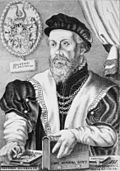
Something wrong?Azariah ben Moses dei Rossi was an Italian-Jewish physician, rabbi, and scholar. He was born at Mantua in c. 1511; and died in 1578. He was descended from an old Jewish family which, according to tradition, was brought by Titus from Jerusalem.
Also in Deutsch
Photos 1

Writers born in the 1510s 6



About this person
Azariah ben Moses dei Rossi was an Italian-Jewish physician, rabbi, and scholar. He was born at Mantua in c. 1511; and died in 1578. He was descended from an old Jewish family which, according to tradition, was brought by Titus from Jerusalem. He was known among Jews as Azariah min-Ha'adumim, a play on his name as well as a possible allusion to the fact that he lived in Catholic Italy, Rome being regarded as a spiritual heir of Esau. Combining an insatiable desire for learning with remarkable mental power, Dei Rossi early in life became exceptionally proficient in Hebrew, Latin, and Italian literature. He became known for his critical thinking and erudition. He studied simultaneously medicine, archeology, history, Greek and Roman antiquities, and Christian ecclesiastical history. When about the age of thirty he married and settled for a time at Ferrara. Later he was found at Ancona, Bologna, Sabbioneta, and again at Ferrara. In 1570 a terrible earthquake visited the last-named city and caused the death of about 200 persons. The house in which Dei Rossi lived was partly destroyed; but it happened that at the moment he and his wife were in their daughter's room, which remained uninjured. During the disturbances consequent upon the earthquake Dei Rossi lived in an outlying village, where he was thrown into association with a Christian scholar, who asked him if there existed a Hebrew translation of the Letter of Aristeas. Dei Rossi answered in the negative, but in twenty days he prepared the desired translation, which he entitled Hadrat Zekenim. His account of the earthquake, written shortly after, is entitled Kol Elohim; he regarded the earthquake as a visitation of God, and not merely as a natural phenomenon.
Fame.am measures public visibility signals. It does not measure human value, talent, morality, or credibility.