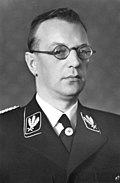
Arthur Seyss-Inquart
✓ Source-basedfallingAustrian Nazi politician, and Nazi ruler of occupied Netherlands, convicted of crimes against humanity and sentenced to death (1892-1946)
He delivered Austria to Hitler in two days as chancellor, then administered Nazi occupation in Poland and the Netherlands - where he oversaw the deportation and murder of the vast majority of Dutch Jews. Hanged at Nuremberg.
Also inDeutsch
Photos 8
 Arthur Seyss-Inquart
.jpg?width=1200) Arthur Seyss-Inquart (1925)
Arthur Seyss-Inquart (1925) Bundesarchiv Bild 119-5243, Wien, Arthur Seyß-Inquart
 Bundesarchiv Bild 183-2006-1106-506, Wien, Empfang von Schauspieler durch Goebbels
 Bundesarchiv Bild 183-E11354, Berlin, Reichstagssitzung, Rede Adolf Hitler
 Bundesarchiv Bild 121-1976, Arthur Seyß-Inquart
 Frank und Seyss-Inquart
In their own words 4
The Jews are the enemy of National Socialism.
Speech in Amsterdam, March 12, 1941. Quoted in "The Trial of the Germans" - Page 468 - by Eugene Davidson - History - 1997
The Fuehrer declared that the Jews have played their final act in Europe, and therefore they have played their final act.
Speech in Amsterdam, March 12, 1941. Quoted in "The Scourge of the Swastika: A Short History of Nazi War Crimes" - Page 248 - World War,
The National Socialist Party in Austria never tried to hide its inclination for a greater Germany.
Speech in Berlin, April 7, 1938. Quoted in "The Trial of the Germans" - by Eugene Davidson - History - 1997
Awards 16
Connected to Arthur 6


About this person
Arthur Seyss-Inquart fought with distinction for Austria-Hungary in World War I, then built a successful law practice and rose through the governments of Chancellors Dollfuss and Schuschnigg. In 1938, as Germany threatened invasion, Schuschnigg resigned and Seyss-Inquart was installed as his successor on 11 March; within two days he transferred power to Germany and Austria became the province of Ostmark, with Seyss-Inquart as its governor. During World War II he served briefly as deputy governor in occupied Poland, then from 1940 as Reichskommissar of the occupied Netherlands, where he instituted a reign of terror: Dutch civilians were subjected to forced labour, hostages shot, and the vast majority of Dutch Jews deported and murdered. The Nuremberg tribunal found him guilty of war crimes and crimes against humanity. He was executed by hanging on 16 October 1946.
Fame.am measures public visibility signals. It does not measure human value, talent, morality, or credibility.