Anatole France is read about 765 times a day, in 97 languages.
A typical day, 30 days to 15 October 2026
The middle day of the days counted, so one week of news cannot move it. The line under it is the last 390 days, one point a day.
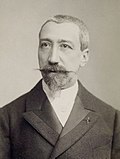
Something wrong?The skeptical ironist who embodied the French literary ideal at the turn of the century - and became the fictional hero Bergotte in Proust's masterpiece.
A life in dates
Also in Deutsch
Photos 8
 Anatole France young years
 15-11-1923, élections à l'Institut, arrivée de M. Anatole France - btv1b53120953x
 Anatole France, Foto von Robert Sennecke
_(14766229852).jpg?width=1200) A painter of dreams, and other biographical studies (1916) (14766229852)
A painter of dreams, and other biographical studies (1916) (14766229852) Anatole France - Caricature d'Ernest La Jeunesse
 Anatole France - Clemenceau - L'Humanité - 1906
.jpg?width=1200) Anatole France - Vie de Jeanne d’Arc, 1908, tome 1 (page 7 crop)
Anatole France - Vie de Jeanne d’Arc, 1908, tome 1 (page 7 crop) Anatole France annales politiques
In their own words 10
 ,
, Mael, a scion of a royal family of Cambria, was sent in his ninth year to the Abbey of Yvern so that he might there study both sacred and profane learning.
A beautiful fig-tree raised itself in a hollow of the island and thrust forth its branches far and wide. The inhabitants of the island used to worship it.
And to me it seems that you have fallen asleep upon a white rock, and in a parish of dreams, and have dreamt all this in a moment while it was night.
Awards
Family
Anatole FrancePartners
Is this everyone?
Only relatives with a profile here are drawn, so a family can be larger than this. A line here can also be wrong.
Correct this familyAbout this person
Born François-Anatole Thibault on 16 April 1844, he built a career as poet, journalist, and novelist, producing several best-sellers under the name Anatole France. His writing - ironic, skeptical, marked by nobility of style and what the Nobel committee called "a true Gallic temperament" - made him the archetypal French man of letters in his era. The Académie Française admitted him to its ranks, and in 1921 he won the Nobel Prize in Literature for achievements defined by profound human sympathy and grace. Proust is widely believed to have modeled Bergotte, the narrator's literary idol in In Search of Lost Time, on France. He died 12 October 1924.





Fame.am measures public visibility signals. It does not measure human value, talent, morality, or credibility.