Amir Khusrow is read about 520 times a day, in 69 languages.
A typical day, 30 days to 15 October 2026
The middle day of the days counted, so one week of news cannot move it. The line under it is the last 390 days, one point a day.
Something wrong?He's called the father of qawwali and the voice of India - a 13th-century Sufi poet who wrote in Persian and Hindavi, bridging devotional music and courtly verse in ways that still shape how the subcontinent sings.
A life in dates
Also in Deutsch
Photos 8
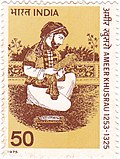
 Amir Khusrow 1975 stamp of India
 "Entertainment in a Garden", Folio from a Khamsa of Amir Khusrau Dihlavi, Matla' al-Anvar MET 57.51.12
 "Entertainment in a Garden", Folio from a Khamsa of Amir Khusrau Dihlavi, Matla' al-Anvar MET DP328568
 "Entertainment in a Garden", Folio from a Khamsa of Amir Khusrau Dihlavi, Matla' al-Anvar MET DP331525
 "Entertainment in a Garden", Folio from a Khamsa of Amir Khusrau Dihlavi, Matla' al-Anvar MET sf57-51-12r
 "Entertainment in a Garden", Folio from a Khamsa of Amir Khusrau Dihlavi, Matla' al-Anvar MET sf57-51-12v
_of_Amir_Khusrau_Dihlavi_MET_DP246515.jpg?width=1200) "Khizr Comes to the Ascetic's Cell", Folio from a Khamsa (Quintet) of Amir Khusrau Dihlavi MET DP246515
"Khizr Comes to the Ascetic's Cell", Folio from a Khamsa (Quintet) of Amir Khusrau Dihlavi MET DP246515_of_Amir_Khusrau_Dihlavi_MET_ISL152.jpg?width=1200) "Khizr Comes to the Ascetic's Cell", Folio from a Khamsa (Quintet) of Amir Khusrau Dihlavi MET ISL152
"Khizr Comes to the Ascetic's Cell", Folio from a Khamsa (Quintet) of Amir Khusrau Dihlavi MET ISL152In their own words 10
 ,
, On Tuesday, the 3rd of Ziqad in AH 700 (10 July, 1301), the strong fort [of Ranthambhor] was conquered. Jhain which was the abode of the infidels, became a new city for Musalmans.
When he advanced from the capital of Karra, the Hindus, in alarm, descended into the earth like ants.
During the attack, the catapults were busily plied on both sides… ‘Praise be to God for his exaltation of the religion of Muhammad.
Family
Parents
Amir KhusrowIs this everyone?
Only relatives with a profile here are drawn, so a family can be larger than this. A line here can also be wrong.
Correct this familyAbout this person
Abu'l Hasan Yamīn ud-Dīn Khusrau was born in 1253 and lived through the Delhi Sultanate as a court poet, musician, and scholar. A mystic and spiritual disciple of Nizamuddin Auliya, he wrote primarily in Persian but also in Hindavi, producing work across eleven metrical schemes and verse forms from ghazal to masnavi. He introduced the ghazal style of song into India and is credited as the father of qawwali, the devotional Sufi singing tradition. His mastery ranged from Khāqānī's qasidas to Nizami's khamsa, and he's attributed with the Ḳhāliq Bārī, a vocabulary in verse mixing Arabic, Persian, and Hindavi terms. He died in October 1325, leaving a legacy that threads through the music and poetry of India and Pakistan centuries later.



Fame.am measures public visibility signals. It does not measure human value, talent, morality, or credibility.