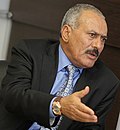
Ali Abdullah Saleh
✓ Source-basedfallingPresident of North Yemen (1978-1990) and Yemen (1990-2012)
He held power in Yemen for more than three decades - first the North, then the unified state - surviving civil wars, coup attempts, and an insurgency, only to die in 2017 at the hands of former allies who shot him during a firefight in Sanaa.
Also inDeutsch
Photos 8
.jpg?width=1200)


_(cropped).jpg?width=1200)
.jpg?width=1200)
.jpg?width=1200)
.jpg?width=1200)

In their own words 3
Ruling Yemen is hard. I always say it’s like dancing on the heads of snakes
The Man Who Danced on the Heads of Snakes Dec 2017)
Yemen is an essential partner of the United States of America and the international community in combating terror.
President Bush Welcomes President Ali Abdullah Saleh of Yemen to the White House (May 2007)
You should continue carrying your arms, ready to sacrifice your lives in defence against these belligerent attacks
Referring to the Houthis (members of a rebel group) in Yemen, as quoted in "Will the Houthis abandon Ali Abdullah Saleh?" at
Awards 8
In their orbit 11
Connected to Ali 6


About this person
A veteran of North Yemen's civil war, Saleh became president in July 1978 after his predecessor's assassination, consolidating control through a turbulent decade of rebellions and a military defeat against the South. By the mid-1980s he had stabilized the North and drawn support from both Washington and Moscow. When South Yemen collapsed in 1986, he engineered reunification in 1990, sharing power until a brief 1994 civil war - won with the help of jihadist fighters - allowed him to revert to autocratic rule. His opposition to the Gulf War cost him Saudi favor and triggered a mass Yemeni exodus, but after 2001 he courted Western governments during the war on terror, even as evidence surfaced that he tolerated or encouraged Islamic terrorism to justify the alliance. The 2011 Arab Spring forced his resignation the following year. In 2015 he allied with the Houthi rebels he had once fought; two years later, after declaring he would switch sides again, a Houthi sniper killed him as battle raged around his compound.
Fame.am measures public visibility signals. It does not measure human value, talent, morality, or credibility.