Alexandre Dumas fils is read about 983 times a day, in 69 languages.
A typical day, 30 days to 15 October 2026
The middle day of the days counted, so one week of news cannot move it. The line under it is the last 390 days, one point a day.
Something wrong?He wrote one novel that became Verdi's La traviata and spent the rest of his career stepping out of his father's shadow - the son of the man who gave the world The Three Musketeers.
A life in dates
Also in Deutsch
Photos 8
 Alexandre Dumas fils
 A. Dumas fils - caricature, en pied, de trois quarts, à gauche - dessin - Nadar - btv1b8539938g (1 of 2)
 Album photographique de Ludovic Halévy. Volume I. Années 1860-1880 - btv1b53247621z (05 of 52)
 Alexandre Dumas Fils - série des "Immortels passés, présents ou futurs" (pl. I.) - (estampe) (2ème état) - Félix Vallotton - btv1b6951597k
 Alexandre Dumas fils, le dimanche 4 novembre, devant la tombe de Gustave Doré, au Père-Lachaise
 Cham - Charivari - V5d245-b
 Correspondance - Buste d'Alexandre Dumas - Le Figaro - 1er août 1867 - page 2 - 5ème colonne
 Edouard Dantan Un Entracte à la Comédie-Française un soir de première, en 1885
Awards
Family
Parents


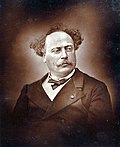 Alexandre Dumas fils
Partners

Children


Brothers and sisters


Is this everyone?
Only relatives with a profile here are drawn, so a family can be larger than this. A line here can also be wrong.
Correct this familyAbout this person
Alexandre Dumas fils was born 27 July 1824, carrying a surname already famous: his father, Alexandre Dumas père, had written The Three Musketeers and The Count of Monte Cristo. The son turned to writing himself and published La Dame aux Camélias in 1848, a romantic novel that caught fire. Five years later Giuseppe Verdi adapted it into the opera La traviata, and the story went on to stage and film again and again. Dumas fils built a career as both novelist and playwright, though that one early work remained his calling card. The Académie française admitted him in 1874; twenty years later he received the Legion of Honour. He died 27 November 1895, having carved out a name that was his own, even if it still came with "fils" attached.


Fame.am measures public visibility signals. It does not measure human value, talent, morality, or credibility.