Albert I of Belgium
King of the Belgians from 1909 to 1934 (1875-1934) · Belgium · Historical Figures · Died at 58
Albert I of Belgium is read about 1,593 times a day, in 63 languages.
A typical day, 30 days to 15 October 2026
The middle day of the days counted, so one week of news cannot move it. The line under it is the last 390 days, one point a day.
Something wrong?He held the throne while his country became a battlefield. Albert I refused to flee when Germany invaded in 1914, commanded his army from the last free corner of Belgium, and earned a nickname that stuck: the Soldier King.
A life in dates
Also in Deutsch
Photos 12

 Equestrian statue of King Albert I (Courtens, 1951) in front of the Royal Library of Belgium in Brussels
 King Albert touring the Belgian Congo during his visit in 1909
 Newspaper compilation in December 1909 shows Albert at top left after inspection of a mine. His wife and children are at bottom right.
 King Albert I and Queen Elisabeth praying to Our Lady of the Sablon, stained glass
 Sword of honor offered by the city of Paris to Albert I of Belgium
 Lucien Frank, Residence of King Albert I during WW I in De Panne, 1915.
 Albert wearing the uniform of a British infantry officer inspecting the front line with British and Belgian officers.
In their own words 10
 ,
Brilliant reception at the station. Children are tidied up as soon as they enter the mission grounds. There is perfect order. The mission makes a big impression.
The reception was enthusiastic and brilliant. The city appears largely mapped out, too bad there are so many ugly buildings that make it look like a city in the American Far West.
Visit of the incomparable and impressive installations of Union Minière. We go up the hill.
Awards
Family
Parents
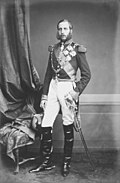
 Albert I of Belgium
Partners

Children
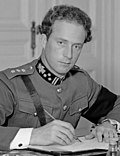


Brothers and sisters


Is this everyone?
Only relatives with a profile here are drawn, so a family can be larger than this. A line here can also be wrong.
Correct this familyAbout this person
Albert was born in Brussels on 8 April 1875, the second son of Prince Philippe, Count of Flanders, and came to the throne in 1909 when his uncle Leopold II died. He married Elisabeth of Bavaria and they had three children. Five years into his reign, German forces swept into Belgium and occupied most of the country. Albert stayed, led what remained of the Belgian army, and became the Knight King to a population under siege. When the war ended in 1918, he oversaw Belgium's adoption of the Treaty of Versailles in June 1919 and the years of reconstruction that followed, while also presiding over the Belgian Congo and the League of Nations mandate of Ruanda-Urundi. The last stretch of his rule brought the opening years of the Great Depression. On 17 February 1934, at 58, he died in a mountaineering accident in eastern Belgium, and his son Leopold III took the throne.


Fame.am measures public visibility signals. It does not measure human value, talent, morality, or credibility.