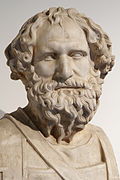
Agesilaus II
King of Sparta · Politicians · Lived 444 BC to 360 BC · aged 84
Agesilaus II is read about 162 times a day, in 48 languages.
Counted to 17 September 2026, not since.
The middle day of the days counted, so one week of news cannot move it. The line under it is the last 60 days, one point a day.
Something wrong?A Spartan king whose battlefield courage couldn't save him from his own diplomatic blindness. Agesilaus II presided over Sparta's brief moment as supreme power in Greece, then watched Thebes shatter it at Leuctra in 371 BC, ending an empire he'd been too rigid to preserve.
Also in Deutsch
Photos 4


In their own words 9
 ,
Observing that a certain malefactor bore torture with remarkable firmness, he said, “What a great rogue he must be, whose courage and constancy are bestowed on crime alone!
When asked what boys should learn, he replied, “That which they will use when men.
From this course of life, we reap liberty.
Family
Parents
 Agesilaus II
Partners
Brothers and sisters


Is this everyone?
Only relatives with a profile here are drawn, so a family can be larger than this. A line here can also be wrong.
Correct this familyAbout this person
Agesilaus became king of Sparta around 400 BC, stepping into command just as Sparta emerged victorious from the Peloponnesian War. For two decades he was the main actor in Spartan hegemony over Greece, brave in combat but fatally lacking the diplomatic instincts the moment demanded. As Thebes grew stronger, his inflexibility turned liability: the Theban victory at Leuctra in 371 BC broke Sparta's supremacy and reduced it to a secondary power for the remainder of his reign. He ruled until around 360 BC, his legacy preserved in starkly opposed accounts - his friend Xenophon wrote both a sweeping history and a panegyric biography to defend him, while the Hellenica Oxyrhynchia and later writers carried a far more hostile tradition. Plutarch's biography centuries later filled in what Xenophon had carefully left out.
Politicians born in the 450s BC 6


Fame.am measures public visibility signals. It does not measure human value, talent, morality, or credibility.