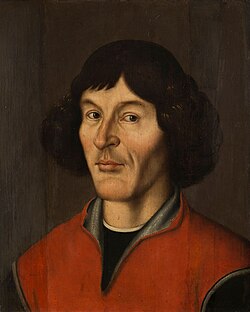
What kind of moment: History, Revolution
Copernican Revolution begins
- When
- 1543
- Where
- Kingdom of Poland
- Author's death
- May 24, 1543 (same year as publication)
Nicolaus Copernicus published De revolutionibus orbium coelestium in 1543, arguing that Earth orbits the Sun rather than sitting at the center of the universe. The Polish astronomer's heliocentric model didn't immediately overturn centuries of Aristotelian thinking, but it cracked the foundation of how Western civilization understood its place in the cosmos.
Copernicus didn't single-handedly destroy geocentrism - that took Galileo's telescope, Kepler's math, and Newton's physics. But he published the first mathematically coherent alternative, giving later astronomers the framework to build on. The shift from Earth-centered to Sun-centered cosmology rippled far beyond observatories, eventually reshaping how humans thought about their significance in nature.
In numbers
- Author's death
- May 24, 1543 (same year as publication)
- Dominant model before Copernicus
- Ptolemaic geocentrism (Earth-centered, established ~150 AD)
How it unfolded
Copernicus Born
Copernicus Develops Heliocentric Theory
While serving as a canon in Frombork, Copernicus develops his heliocentric model, placing the Sun at the center of the universe rather than Earth. He circulates a manuscript outline among colleagues but delays formal publication.
Catholic Church Suspends De revolutionibus
The Congregation of the Index places Copernicus's work on the Index of Prohibited Books pending corrections, citing conflict with scriptural interpretation. The ban remains until 1835.
Galileo Publishes Dialogue on Two World Systems
Galileo Galilei publishes his defense of heliocentrism in Florence, advancing Copernicus's theory with telescopic observations. He faces Church trial and house arrest.
Newton's Principia Provides Mathematical Foundation
Isaac Newton publishes Philosophiæ Naturalis Principia Mathematica in London, providing gravitational mechanics that mathematically validates the heliocentric model.
Bradley Confirms Heliocentrism Through Aberration
Astronomer James Bradley observes stellar aberration, providing the first direct empirical evidence of Earth's motion around the Sun and strong confirmation of Copernicus's model.
- What followed
1600: Shift in Religious and Philosophical Authority
- What followed
1687: Development of Modern Scientific Method
- What followed
1700: Psychological Demotion of Humanity