Pierre-Joseph Proudhon
French politician, philosopher, anarchist and socialist (1809-1865) · France · Politicians · Died at 56 · also Belgium
Pierre-Joseph Proudhon is read about 1,144 times a day, in 78 languages.
A typical day, 30 days to 22 October 2026
The middle day of the days counted, so one week of news cannot move it. The line under it is the last 397 days, one point a day.
Something wrong?He coined the phrase "property is theft!" and became the first person to publicly claim the label anarchist - not as an insult but as a position. His 1840 pamphlet launched a political tradition and a lifelong argument with Marx.
A life in dates
Also in Deutsch
Photos 8
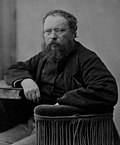
 Portrait Pierre-Joseph Proudhon (cropped)
 16 Représentants montagnards à leurs bancs de l'Assemblée constituante, 1848
 16 Représentants à leurs bancs de l'Assemblée constituante, 1848
 19th century anarchists, Proudhon, Bakunin, Kropotkin (1)
 19th century anarchists, Proudhon, Bakunin, Kropotkin (2)
 19th century anarchists, Proudhon, Bakunin, Kropotkin
 Actes de la révolution
 Alfred Daniel, Iphigenie 1964
In their own words 10
 ,
All my economic ideas as developed over twenty-five years can be summed up in the words: agricultural-industrial federation.
The nineteenth century is in my eyes a creative age in which new principles are produced but in which nothing written will endure.
I should like to restore with one hand what I destroy with the other. When pruning an old tree one should avoid destroying the buds and fruit; you know this is as well as anyone.
Family
Pierre-Joseph ProudhonPartners

Is this everyone?
Only relatives with a profile here are drawn, so a family can be larger than this. A line here can also be wrong.
Correct this familyAbout this person
Born in Besançon in 1809, Proudhon was a printer who taught himself Latin to set books he couldn't otherwise read. What Is Property?, published in 1840, caught the attention of both French authorities and Karl Marx, who began a correspondence that turned into a Paris friendship during Marx's exile. The friendship shattered when Marx answered Proudhon's The System of Economic Contradictions with The Poverty of Philosophy, a dispute that helped split the anarchist and Marxist wings of the International Working Men's Association. Elected to the French Parliament after the 1848 Revolution, Proudhon called himself a federalist and pushed for workers' councils, cooperatives, and a national bank offering interest-free loans funded by a tax on capitalists - an attempt that failed. He died in 1865, leaving a mutualist philosophy that splintered into individualist anarchism, collectivist anarchism, anarcho-communism, and anarcho-syndicalism.


Fame.am measures public visibility signals. It does not measure human value, talent, morality, or credibility.