Norbert Wiener
American mathematician, scientist in cybernetics and artificial intelligence (1894-1964) · United States · Academics · Died at 69
Norbert Wiener is read about 745 times a day, in 64 languages.
A typical day, 30 days to 15 October 2026
The middle day of the days counted, so one week of news cannot move it. The line under it is the last 390 days, one point a day.
Something wrong?He gave the world "cybernetics" - the idea that feedback loops govern both living brains and thinking machines. Before AI became an industry, Wiener saw intelligent behavior as a question of communication and control, a pattern that didn't care whether it ran on neurons or circuits.
A life in dates
Also in Deutsch
Photos 8
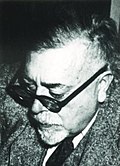
 Norbert wiener
 Gonzalo showing El Ajedrecista to Norbert Wiener
.jpg?width=1200) Internationaler Mathematikerkongress Zürich 1932 - ETH BIB Portr 10680-C-FL (Johannes Meiner)
Internationaler Mathematikerkongress Zürich 1932 - ETH BIB Portr 10680-C-FL (Johannes Meiner).jpg?width=1200) Internationaler Mathematikerkongress Zürich 1932 - ETH BIB Portr 10680-FL (Johannes Meiner)
Internationaler Mathematikerkongress Zürich 1932 - ETH BIB Portr 10680-FL (Johannes Meiner) Norbert Wiener, Cybernetics. 1958. First Russian edition
 Norbert Wiener
 PrincipiaDiscordia pg00047
 Sign of N. Wiener
In their own words 10
 ,
, It is my thesis that machines can and do transcend some of the limitations of their designers...
The terms "black box" and "white box" are convenient and figurative expressions of not very well determined usage.
The most fruitful areas for the growth of the sciences were those which had been neglected as a no-man's land between the various established fields.
Awards
Family
 Norbert Wiener
Partners
Brothers and sisters
Is this everyone?
Only relatives with a profile here are drawn, so a family can be larger than this. A line here can also be wrong.
Correct this familyAbout this person
Norbert Wiener was a child prodigy who became a professor of mathematics at MIT and spent decades chasing stochastic processes and mathematical noise - work that fed directly into electronic engineering and communication systems. In the 1940s he crystallized cybernetics, a science of how information flows through organisms and machines alike, bridging biology, neuroscience, systems control, and philosophy. The framework influenced John von Neumann, Claude Shannon, Margaret Mead, Gregory Bateson, and a generation of thinkers who saw the world as networks of signals. Wiener also theorized early that feedback mechanisms could simulate intelligent behavior in machines, planting a seed that would grow into artificial intelligence. He died on March 18, 1964, decades before the terminology became inescapable.
In common with Norbert



Academics from the United States 1
Fame.am measures public visibility signals. It does not measure human value, talent, morality, or credibility.