Mithridates I of Parthia
King of Parthian Empire from 165 to 132 BC · Historical Figures · Lived 195 BC to 132 BC · aged 63
Mithridates I of Parthia is read about 221 times a day, in 48 languages.
Counted to 18 September 2026, not since.
The middle day of the days counted, so one week of news cannot move it. The line under it is the last 60 days, one point a day.
Something wrong?Mithridates I, also known as Mithridates the Great, was king of the Parthian Empire from 165 BC to 132 BC. During his reign, Parthia was transformed from a small kingdom into a major political power in the Ancient Near East as a result of his conquests.
Also in Deutsch
Photos 6

 Bronze coin of Mithridates I, with the image of an elephant on the reverse, possibly as a celebration of the conquest of Bactria
 Tetradrachm of Demetrius II Nicator, basileus of the Seleucid Empire
 Early coin of Mithridates I. The reverse shows a seated archer carrying a bow, whilst the obverse shows a portrait of Mithridates I wearing a soft cap (bashlyk)
 Mithridates I's portrait on the obverse of a tetradrachm, showing him wearing a beard and a royal Hellenistic diadem on his head. The reverse shows Heracles-Verethragna, holding a club in his left hand and a cup in his right hand
 The Xong-e Noruzi relief in Khuzestan
Family

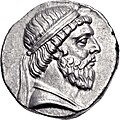 Mithridates I of Parthia
Partners
Children


Brothers and sisters


Is this everyone?
Only relatives with a profile here are drawn, so a family can be larger than this. A line here can also be wrong.
Correct this familyAbout this person
Mithridates I, also known as Mithridates the Great, was king of the Parthian Empire from 165 BC to 132 BC. During his reign, Parthia was transformed from a small kingdom into a major political power in the Ancient Near East as a result of his conquests. He first conquered Aria, Margiana and western Bactria from the Greco-Bactrians sometime in 163-155 BC, and then waged war with the Seleucid Empire, conquering Media and Atropatene in 148/7 BC. In 141 BC, he conquered Babylonia and held an official investiture ceremony in Seleucia. The kingdoms of Elymais and Characene shortly afterwards became Parthian vassals. In c. 140 BC, while Mithridates was fighting the nomadic Saka in the east, the Seleucid king Demetrius II Nicator attempted to regain the lost territories; initially successful, he was defeated and captured in 138 BC, and shortly afterwards sent to one of Mithridates I's palaces in Hyrcania. Mithridates I then punished Elymais for aiding Demetrius, and made Persis a Parthian vassal.
Historical Figures born in the 200s BC 2
Fame.am measures public visibility signals. It does not measure human value, talent, morality, or credibility.