Lester B. Pearson
14th Prime Minister of Canada, from 1963 to 1968 (1897-1972) · Canada · Politicians · Died at 75
Lester B. Pearson is read about 467 times a day, in 73 languages.
A typical day, 30 days to 22 October 2026
The middle day of the days counted, so one week of news cannot move it. The line under it is the last 397 days, one point a day.
Something wrong?He won the Nobel Peace Prize in 1957 for cooling the Suez Crisis with a UN force - then spent six years losing elections before finally reaching the prime minister's office.
A life in dates
Also in Deutsch
Photos 11

 A memorial plaque on the location of his birthplace
 Pearson serving with the Canadian Army Medical Corps in World War I in Salonika
 Ice hockey in Europe; Oxford University vs. Switzerland, 1922. Future Canadian prime minister Lester Pearson is at right front. His nickname from the Swiss was "Herr Zig-Zag".
 Pearson with John Ross McLean, Vincent Massey and Georges Vanier on 1 January 1938 at Canada House, London
 Pearson presiding at a plenary session of the founding conference of the United Nations Food and Agriculture Organization in 1945.
 Prime minister Louis St. Laurent (far left) and Pearson (far right) welcome UK prime minister Sir Winston Churchill and foreign secretary Sir Anthony Eden at Rockcliffe Airport, Ottawa, on 29 June 1954.
 René Levesque interviews Pearson in Moscow, 1955
Awards
Family
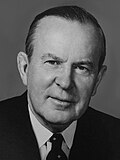 Lester B. Pearson
Partners
Is this everyone?
Only relatives with a profile here are drawn, so a family can be larger than this. A line here can also be wrong.
Correct this familyAbout this person
Lester Pearson came up through External Affairs, serving as Canada's ambassador to the United States from 1944 to 1946 before entering politics in 1948 as Secretary of State for External Affairs under Mackenzie King and St. Laurent. He chaired the UN General Assembly in 1952, nearly became secretary-general in 1953 until the Soviets vetoed him, then proposed the UN Emergency Force for Suez in 1957 and took the Nobel for it. He won the Liberal leadership in 1958 and lost twice to John Diefenbaker before defeating him in 1963 and governing on two straight minority mandates through 1968. In five years he launched the Canada Pension Plan, the Canada Student Loan Program, universal health care, the Canada Labour Code, the Auto Pact with Washington, royal commissions on bilingualism and the status of women, the unification of the Armed Forces, the Maple Leaf flag after a bitter national debate, the world's first points-based immigration system, and the 1967 Centennial celebrations - while keeping Canada out of Vietnam. He resigned in 1968 and died four years later, ranked among the country's greatest prime ministers.
In common with Lester

Politicians from Canada 5


Fame.am measures public visibility signals. It does not measure human value, talent, morality, or credibility.