Leopold I of Belgium
German prince who became the first King of the Belgians (1790-1865) · Germany · Historical Figures · Died at 74
Leopold I of Belgium is read about 1,744 times a day, in 72 languages.
A typical day, 30 days to 15 October 2026
The middle day of the days counted, so one week of news cannot move it. The line under it is the last 390 days, one point a day.
Something wrong?He turned down Greece, took Belgium instead, and became the first king of a brand-new country assembled by treaty in 1831 - chosen because his diplomatic bloodlines stretched across Europe and his British ties made him safe for the balance of power.
Also in Deutsch
Photos 8
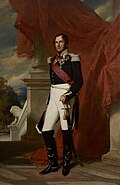
 1840 portrait of King Leopold I (King of the Belgians) by Winterhalter
 Algemene Tentoonstelling van Schone Kunsten te Brussel, ter ere van LeopoldI, koning der Belgen, NG-VG-1-3838
 Belgien 1863 20 Cent
 Belgien 1865 20 Cent
 Besluit van Leopold I, koning der Belgen tot bijeenroeping van de volksverte-genwoordiging, NG-VG-1-3668
 Brabançonne postcard 07
 Bruxelles à travers les âges (1884) (14763437515)
 Crypte royale Laeken 901
In their own words 10
 ,
Belgium is a boiler that needs valves.
He is as uncontrollable and crabby as one can imagine. Not to be understood, because neither his mother nor his father is like that.
My heart knows of no other ambition than that of seeing you happy.
Awards
Family
Parents

 Leopold I of Belgium
Partners


Children



Brothers and sisters


Is this everyone?
Only relatives with a profile here are drawn, so a family can be larger than this. A line here can also be wrong.
Correct this familyAbout this person
The youngest son of a minor German duke, Leopold fought Napoleon in the Russian army after French troops rolled through Saxe-Coburg. He moved to Britain in 1816 and married Princess Charlotte of Wales; the marriage was happy but ended after a year and a half when she died delivering a stillborn son. He stayed on in Britain with considerable status. After the Greek War of Independence he was offered the Greek throne under the 1830 London Protocol but turned it down as too precarious. Belgium, newly independent in 1830, offered him its crown instead - he had the royal connections and wasn't aligned with France or other powers that might upset the Vienna settlement. He took his oath on 21 July 1831, married Princess Louise of Orléans the next year, and had four children with her plus two sons by his mistress Arcadie Claret. His reign saw Dutch attempts to recapture the country, internal splits between Liberals and Catholics, and his own quiet expansion of royal power through constitutional ambiguity. He pushed economic modernization, helped fund Belgium's first railway in 1835, and blocked the 1848 revolutions from spreading into his kingdom. He died in 1865 and le


Fame.am measures public visibility signals. It does not measure human value, talent, morality, or credibility.