Friedrich Schleiermacher
German theologian, philosopher, and biblical scholar (1768-1834) · Academics · Died at 65
Friedrich Schleiermacher is read about 363 times a day, in 53 languages.
A typical day, 30 days to 16 September 2026
The middle day of the days counted, so one week of news cannot move it. The line under it is the last 361 days, one point a day.
Something wrong?He tried to save Christianity from the Enlightenment by rewriting its foundations - and ended up fathering modern liberal theology, a move so influential that Karl Barth spent much of the twentieth century trying to undo it.
Also in Deutsch
Photos 8
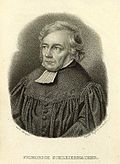
 Friedrich Daniel Ernst Schleiermacher

 Berlin, Kreuzberg, Bergmannstrasse, Dreifaltigkeitsfriedhof II, Grab Friedrich Schleiermacher, Bueste
 Berliner Wespen 1868 - Zum Schleiermacher-Fest
 Breslau und Umgebung 063b
 Christelijke encyclopædie voor het Nederlandsche volk 5-091
 Confirmations-Schein Berlin 1831-03-31
 DBP-B Friedrich Schleimacher 20 Pf 1957
In their own words 5
 ,
But the imparting of religion is not to be sought in books, like that of intellectual conceptions and scientific knowledge.
Miracle is simply the religious name for event. Every event, even the most natural and usual, becomes a miracle, as soon as the religious view of it can be the dominant.
Him pervaded the Cosmic Spirit, the Infinity was his beginning and his end, the Universe his only and everlasting love.
Family
Is this everyone?
Only relatives with a profile here are drawn, so a family can be larger than this. A line here can also be wrong.
Correct this familyAbout this person
Friedrich Daniel Ernst Schleiermacher was born on 21 November 1768 into German Reformed tradition, trained as a theologian and pastor at a moment when Enlightenment criticism was tearing at Protestant orthodoxy. His project was reconciliation: he set out to answer the skeptics without abandoning faith, and in doing so he reshaped how biblical texts could be read and interpreted. That work made him a pioneer of higher criticism and laid groundwork for modern hermeneutics, the art of interpretation itself. As a philosopher he rode the German Romantic wave, but it was his recasting of theology - making feeling and experience central - that earned him the title "Father of Modern Liberal Theology" and a long shadow over Christian thought. He died on 12 February 1834, leaving a legacy so large that the neo-orthodox movement, often linked to Karl Barth, defined itself partly as a rebellion against him.



Fame.am measures public visibility signals. It does not measure human value, talent, morality, or credibility.